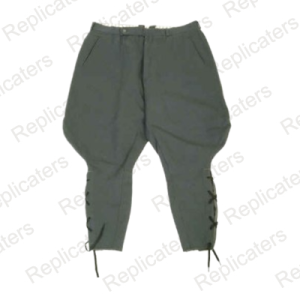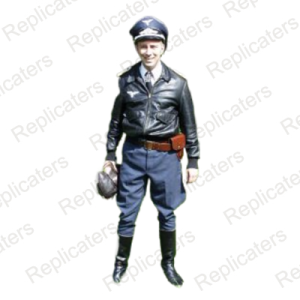

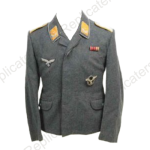
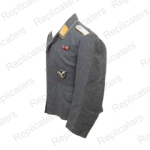
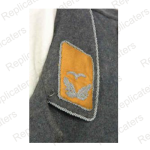


The WWII German Luftwaffe Fliegerbluse was a short field and service tunic introduced in 1935 for all Luftwaffe ranks. Originally designed for flight personnel, it was soon adopted across the Luftwaffe as a general service and combat blouse due to its practicality, comfort, and sharp profile.
Our 100% precise replication of the Fliegerbluse tunic is tailored from wool-blend cloth. The Fliegerbluse featured a soft, collarless front-closure design with concealed buttons and internal pockets, emphasizing functionality over parade appearance. It was worn by pilots, paratroopers (Fallschirmjäger), flak crews, ground troops, and administrative staff alike.
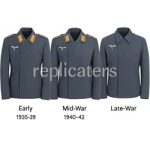
Below are details of the three main wartime models:
Model 1 – Early Pattern (1935–1939)
• Constructed from fine blue-grey wool doeskin.
• Features internal hook-and-eye closure with a smooth, fly-front (hidden button) design.
• Two internal chest pockets with button closures, no external pockets.
• Dark blue collar facing with branch-colored collar tabs and sewn-in shoulder straps.
• Silver-grey embroidered Luftwaffe eagle applied above the right breast.
• Tailored close-fitting design, favored by early aircrew and parade wear.
Model 2 – Mid-War Pattern (1940–1942)
• Simplified for mass issue; made from coarser wool serge or wool-rayon blend.
• removable shoulder boards (buttoned type).
• Retained hidden button front and internal pockets.
• Collar became plain blue-grey, without contrasting facing.
• Collar tabs and eagle were machine-stitched; fewer hand-tailored details.
• Designed for wide use by flight and ground personnel.
Model 3 – Late-War Pattern (1943–1945)
• Further simplified construction for wartime econom
• Used field-grey / blue-grey mixed wool .
• Open collar design (can be worn with or without shirt and tie).
• Luftwaffe eagle often applied as printed cloth insignia rather than embroidery.
• Minimal tailoring and simplified stitching—no internal pockets entirely.
• Widely issued to Luftwaffe field divisions and paratroopers in the final war years.